2026 OpenClaw coupled to local Ollama on a rented Mac mini M4 16GB: loopback 127.0.0.1:11434, one 7B–8B Q4 lane, Node 22+, launchd boot order, memory gates, and a twelve-step smoke ladder
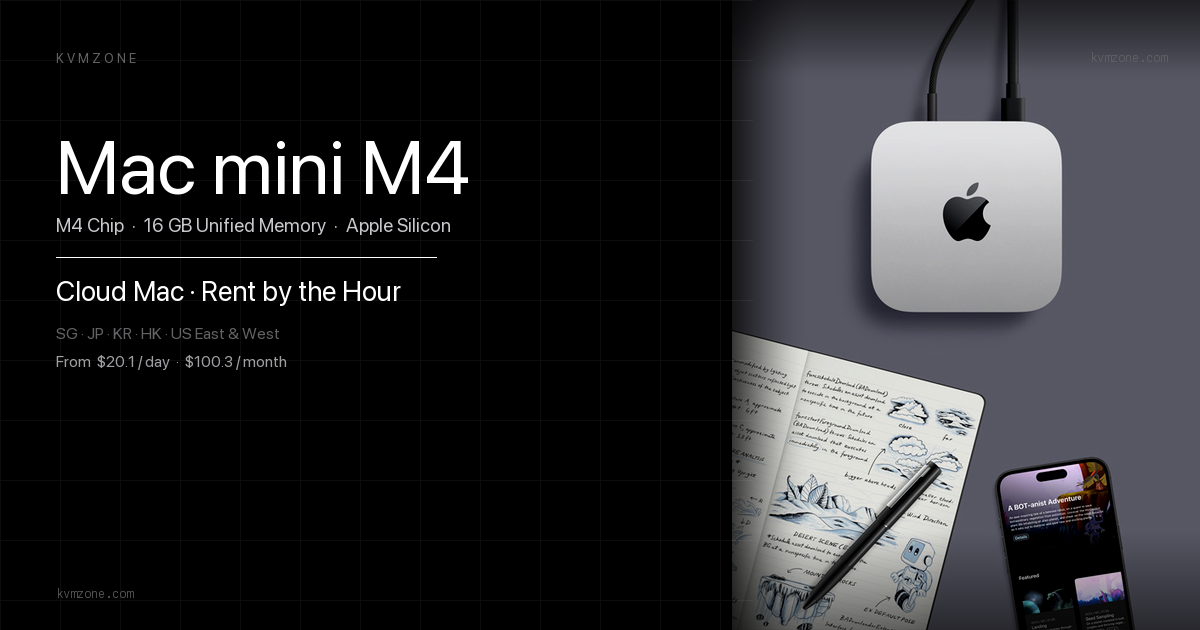
OpenClaw is the orchestration lane; Ollama is the on-box inference lane. On a rented Mac mini M4 with 16GB unified memory, the coupling pattern is deliberate: OpenClaw handles webhooks, skills, and provider routing while Ollama serves one quantized 7B–8B model over loopback 127.0.0.1:11434. This is not the full AI server lanes matrix—it is the wiring contract finance can quote: Node 22+, launchd boot order (Ollama before OpenClaw), swap under 15%, and a 12-step smoke ladder.
Pair on first mention with OpenClaw hour-zero install contract, steady-state launchd runbook, and unified memory pressure playbook. API surface follows Ollama HTTP API documentation; hardware assumptions follow Apple Mac mini specifications.
Disclosure: KvmZone is the Mac rental provider referenced in this article. Ollama API notes cite Ollama API documentation; hardware notes cite Apple Mac mini specifications.
Why couple OpenClaw to local Ollama on a rented Mac
Teams that already picked the OpenClaw lane still need a model endpoint. Cloud APIs add latency and invoice variance; local Ollama on the same rental keeps prompts on loopback and lets finance cap weights to one 7B–8B Q4_K_M file set. OpenClaw remains the process that wakes on webhooks—Ollama is not a second orchestrator.
| Role | Process | Default bind |
|---|---|---|
| Orchestration | OpenClaw (Node 22+) | Webhook + skills per your runbook |
| Inference | Ollama daemon | 127.0.0.1:11434 (never WAN-expose) |
| Weights | Single GGUF lane | One 7B–8B Q4 model loaded at a time |
| Ops spine | SSH + launchd | See SSH security workflow |
Coupling rules on 16GB unified memory
Sixteen gigabytes is enough for OpenClaw plus one modest local model—until you break the contract. Treat the table below as non-negotiable for pilots.
| Rule | Why | Failure signal |
|---|---|---|
| One model lane | Two 7B weights exceed headroom with Node resident | Swap delta >15% after load |
| Loopback only | Ollama on 127.0.0.1:11434 avoids accidental exposure | Port scan hits from outside SSH tunnel |
| Node 22+ | Matches hour-zero contract | Native module mismatch after reboot |
| Ollama before OpenClaw | Provider health at boot | Webhook retry storm on cold start |
If you also run a cloud client on the same host, isolate secrets per Gemini API client hygiene and never double-load weights while API batch jobs run hot.
Ollama stack floor (pin before ollama pull)
Install Ollama on the rented Mac only after APFS and memory baselines pass. Pull exactly one pilot tag—example family llama3.2:3b or another 7B–8B Q4 you standardize in the runbook.
| Check | Floor | Proof command |
|---|---|---|
| Ollama binary | Current stable for macOS ARM | ollama --version |
| API listen | 127.0.0.1:11434 | curl -s http://127.0.0.1:11434/api/tags |
| Model count | 1 resident 7B–8B Q4 | ollama ps shows one NAME |
| APFS free | ≥25GB before first pull | df -h / |
Generation and chat endpoints follow Ollama’s HTTP API—pin paths in your internal wiki, not from memory.
OpenClaw provider wiring to Ollama
Point OpenClaw’s OpenAI-compatible provider at loopback. Typical pattern: base URL http://127.0.0.1:11434/v1, model name matching ollama list, empty or dummy API key when Ollama does not enforce one on localhost.
- Store OpenClaw config outside git; mode 0600 for files holding webhook secrets.
- Smoke with
curlagainst/api/generatebefore enabling skills that fan out concurrent calls. - Cap concurrent skill invocations during pilot—OpenClaw parallelism plus one loaded model is what trips swap on 16GB.
- Graduate daemon config using steady-state launchd runbook log rotation splits.
curl http://127.0.0.1:11434/api/generate -d '{"model":"YOUR_TAG","prompt":"ping","stream":false}'
launchd boot order: Ollama before OpenClaw
Two KeepAlive plists beat one monolithic script. Load order matters: OpenClaw’s health probe must find 11434 listening.
| Order | Label (example) | Gate |
|---|---|---|
| 1 | com.yourorg.ollama | curl -sf http://127.0.0.1:11434/api/tags exits 0 |
| 2 | com.yourorg.openclaw | Webhook stub returns 200 within SLA |
| Reboot test | Both plists | No manual login; see SSH workflow for consent-only GUI |
Memory and disk matrix for the coupled stack
Weights, Node, and skill caches share one APFS pool. Use the triggers below before finance approves production webhooks.
| Signal | Threshold | Action |
|---|---|---|
| Swap vs baseline | >15% after 30‑min pilot | Triage memory playbook or split host |
| APFS free | <18GB | Pause new ollama pull; prune models |
| APFS critical | <12GB | Add 1TB per rent-term matrix |
| OpenClaw logs | >512MB single file | Rotate per steady-state runbook |
Six-region POP for OpenClaw + Ollama pilots
KvmZone nodes: Hong Kong, Japan (Tokyo), Korea (Seoul), Singapore, US East, US West. Latency to 127.0.0.1 is local; region choice is about who SSHes in and which billing TZ owns the rental.
| Pilot profile | Region hint | Pairing article |
|---|---|---|
| CN business-hours ops | Hong Kong or Singapore | AI server lanes |
| JP reviewer TZ + Tokyo SSH | Japan (Tokyo) | OpenClaw hour-zero |
| KR automation beside Seoul | Korea (Seoul) | Parallel jobs matrix |
| US Pacific evening webhooks | US West | Steady-state runbook |
| EU handoff windows | US East | Second host split |
Compare regions on the pricing page before pinning runbook labels—reviewer time zones beat nominal CPU charts.
Twelve-step OpenClaw + Ollama smoke ladder
Run after Ollama upgrade, OpenClaw bump, model tag change, or plist edit. Store screenshots with the invoice week ID finance already uses.
| Step | Gate | Pass |
|---|---|---|
| 1 | SSH | Non-interactive admin shell |
| 2 | Node | 22+ in login and non-login shells |
| 3 | Ollama install | ollama --version OK |
| 4 | Loopback | 127.0.0.1:11434 returns tags JSON |
| 5 | Single model | One 7B–8B Q4 pulled; ollama ps ≤1 NAME |
| 6 | Generate | /api/generate returns body without stream errors |
| 7 | OpenClaw | CLI/help exits 0 over SSH |
| 8 | Provider | OpenClaw completion via loopback provider |
| 9 | launchd order | Ollama plist loads before OpenClaw; reboot pass |
| 10 | Webhook | Stub call 200 with model resident |
| 11 | Memory | Swap <15% vs baseline after 30‑min pilot |
| 12 | Finance | Run URL + pricing screenshot stored with week ID |
If steps 10–11 fail, read memory pressure before blaming model quality.
FAQ
Related reading
- Microsoft Aion 1.0: Windows local Instruct & 14B Plan SLMs — twin on-device SLMs vs Mac Ollama loops
- Mac mini M4 AI server: three workload lanes — lane context (not coupling)
- OpenClaw hour-zero install contract — Node 22+ discipline
- OpenClaw steady-state launchd runbook — logs and skills split
- Unified memory swap pressure playbook — swap triage
- Rent-term parallel light-jobs disk matrix — second host triggers
- Remote Mac SSH vs VNC security workflow — access hygiene
- Gemini 3.5 Flash API client host — cloud client on same rental class
Compare regions before you couple OpenClaw to Ollama
Compare six-region Mac mini M4 rentals on pricing, pin Node 22+ and one 7B Q4 model, start Ollama before OpenClaw in launchd, and pass the twelve-step smoke ladder before production webhooks.